
Creative Industries Research
The creative industries are made up of several sectors who often work alongside each other, working together to complete projects. They include designers, photographers, videographers, artists, product makers, musicians, etc. There are a large variety of people in industry and they often work together in a variety of different ways either by being commissioned by a company or simply to help advertise each other’s work, or for collaboration purposes i.e. a textile artist may make a series of knitwear and then collaborate with a photographer and a videographer to help advertise their work. They may also work with a website designer and/or a product designer to further streamline their advertising process.
Another example of people in industry working together could be that a company requires an advert for a product they are selling; firstly, they must employ a product designer to design how they want to sell this product and who to, then they must employ a graphic designer, a photographer, a videographer, and a musician/s. All of these moving parts are required for one advert and they must work together for its completion and to realise the initial idea put forward to the company commissioning them. An example of this would be in O2’s advert “Breathe it all in” (CAMPAIGN LIVE, 2018, www). For this advert they have a multitude of people working on the project which are listed in the source. Some of these people include Art Director Myles Vincent, writer James Rafter, director Jaron Albertin through Smuggler, as well as a photographer, retoucher, colourist, audio producer etc. Just for this one advert there are around 30 different people collaborating and producing this one piece of work!
As well as cross collaboration from different people in industry it is also becoming more common for individuals to work in more than one sector to maximise profits and exposure, but also to advance their own craft and allow themselves complete creative freedom. Grayson Perry, an artist who is as well known for his transvestism as he is for his pottery, (GRANDE, 2014, www) began branching out into different mediums after his Turner Prize win in 2003, including tapestry, documentary film-making/presenting, and expanding the way in which he creates his ceramics including embossments and photographic transfers to create “intricate, animated surfaces” (ROYAL ACADEMY, 2018, www).
The export of services from the Creative Industries grew by an incredible 27.4% between 2015 and 2016 (DCMS SECTORS ECENOMIC ESTIMATES 2016: TRADE REPORT), culminating in an overall export generation of £27bn! Split between 7 different sectors with IT, Software & Games producing the largest portion of these service exports and Design & Fashion with the smallest. It is reported from DCMS Sector statistics that the Creative Industries contribution to the economy was almost £92bn in 2016 and growing at twice the rate of the rest of the economy, making up more than 5% of the UK economy’s Gross Added Value (GVA) (PATEL, 2017, www).
For my Creative Industries unit, I wanted to explore more about photographers who put on exhibitions and/or own their own galleries. For my work experience I will be spending 2 days with a local Scottish photographer who owns his own gallery and also helps local artists put on their own exhibitions in his gallery space. So, because of this I will be focusing on Fine Art Photographers and how they make their living by putting on exhibitions as well as other areas of photography they may work in to supplement their income.
Fine Art photographers are different to other kinds of photographers (commercial or similar) because the work they create is not about recording what is in front of the camera, it is about recording what they see in their mind by using certain camera controls, editing techniques, or alternative printing techniques to achieve the image that they, and only they, see. Fine Art Photography has no universally agreed on meaning or definition. According to Visual Arts Cork (VISUAL ARTS CORK, 2015, www), “it refers to an imprecise category of photographs, created in accordance with the creative vision of the cameraman”.
Photographers who wish to travel down the Fine Art path come from a variety of technical and educational backgrounds; some may be completely self-taught such as Mikko Lagerstedt:


(LAGERSTEDT).
Whereas other fine art photographers go through educational routes such as local artist Honza Turnovsky who studied their BA in Fine Art at Glasgow School of Art (GSofA):


(TURNOVSKY, 2014).
By going down the educational route i.e. studying for a degree, artists have more access to people who also work in industry and have experience in their chosen specialism (Fine Art) such as Professor Thomas Joshua Cooper, a fine art photographer and lecturer at GSofA who has worked in industry for over 43 years, with almost 95 solo exhibitions in major galleries/museums as well as participating in over 80 group exhibitions, author of 10 visual monographs (a specialist work in writing of one subject, or an aspect of it) and co-authored one historical text-book (COOPER). By having access to people like Cooper, artists will be able to gain knowledge into their industry as well as advice on a variety of things from how to develop their style, how to advertise their work, how to put on exhibitions/galleries, how to gain funding for said exhibitions, and how to think creatively and be able to express themselves.
Employment routes for fine art photographers are varied; from commissioned work, to work that is funded through funding platforms such as “GoFundMe”, “Kickstarter”, and “Patreon”, or through funding from larger organisations such as different “Art Councils” or organisations who offer grants to individuals who meet their criteria (can be dependent on age, locality, subject matter) as well as submitting a well thought out and thoroughly researched proposal, to completely self-funded projects that go on to be shown at galleries/museums.
Artists funding their work through funding platforms firstly need to decide which platform to use; Jessica Stewart provides an in depth look on a variety of platforms in her article “How to Use Crowdfunding to Launch the Creative Project of Your Dreams” (STEWART, 2017, www). Kickstarter is one of the first thought of campaigns, having raised more than $2.8billion at the time of the article, with 15 different categories to choose from for your platform. However, if you do not reach your target goal all of the money raised goes to Kickstarter and you don’t receive any of it. With careful planning and marketing, this can be avoided and by making your goals realistic they are more likely to be reached.
Another example of a crowdfunding platform suggested by Stewart is Patreon. From Patreon’s website we know that Patreon hosts over 100,000 creators, projecting that it will pay out $300 million to creators in 2018 alone which is supported by their 2 million monthly active patrons who support creatives in a variety of different sectors. One artist, Samantha Fisher focuses on Fine Art Animal Right’s Photography and uses Patreon not only to support her financially but to allow her to continue to provide professional images to sanctuaries, and animal rights organisations around the world free of charge (FISHER, 2018, www) as well as raising awareness for animal rights, and for the planet. Although Fisher only makes $632 per month currently, that comprises of 107 patrons who support her one of which paying $100 monthly. Patrons do get things in return however, including access to patron only content, different discounts on Fisher’s online shop (depending on how much is pledged each month), different sized prints at regular intervals (e.g. 3 months for $15pm), early viewing of new content on password protected pages on Fisher’s own website, as well as many other incentives. The more an individual pledges the more they will get in return from the creator. $632 isn’t enough to fully support oneself as an artist however, alongside other methods of funding like commercial work, bursaries or grants, it could be enough to have enough time to comfortably explore and expand on an artist’s true passions.
Another kind of funding is bursaries or grants from organisations who will fund specific projects after receiving, reviewing, and accepting well planned written proposals which outline exactly the intentions of the project; what the artist hopes to gain from said project, the timescale, and the predicted costs. One such organisation is Creative Scotland who have four main categories of funding programmes: “Regular Funding”, “Open Project Funding”, “Targeted Funding”, and “Funds Delivered by Partners”. Regular funding is one of their main funds for artistic and creative organisations, providing long-term funding up to 3 years, although there is no mention on the website of the amount people can apply for. Open project funding is provided for up to 2 years and supports a wider variety of individuals and organisations looking to develop their skills, create something new, develop and present work for new audiences, or projects which encourage others to participate in artistic and creative outlets. For this kind of funding you can apply for anything between £1000 and £150,000 which is provided mostly by money from the National Lottery.
Targeted funding work slightly differently in that only specific specialisms or people working in particular kinds of creative industries are eligible, i.e. Visual Artist and Craft Maker Awards which provide grants for visual and crafting artists through their local authorities. As well as being offered funding, artists can also be granted training programmes, prizes, awards, or artist residencies. Having a residency funded especially could be useful for a Fine Art photographer as they would have funding to travel somewhere that could be relevant to their project without worrying about paying all expenses out of pocket. The Royal Scottish Academy of ART and ARCHITECTURE (RSA) will provide up to £5000 to artists however, artists are solely responsible for managing their own residency, in conjunction with their partner venue. An artist may choose to do a series on rural living, for example, and gain residency in the Outer Hebrides where their surroundings are poignant to their research and development, therefore giving them a deeper reality of their project and being able to expand on it more thoroughly with a truer representation than if they did the project somewhere else, like Glasgow. As well as providing artists with funding, the organisation also aims to “enable artists a period of research, development and production”, “reinforce links with centres of excellence”, “provide access to technical expertise… to learn new skills & techniques”, and “enable the exchange of ideas and practice” (RSA, 2018, www).
The RSA also offer a specific monetary award funded by The Morton Charitable Trust for lens-based media only which consists of a £5000 award to research, develop, and produce a body of work which is new. However, undergraduate and post-graduate students are not eligible for this award.
Commissioned work could be from a variety of different organisations such as hospitals, banks, private corporations, companies, etc who are looking for someone to create a specific or sometimes more generalised piece of work (e.g. that fits a theme or a narrative). Photographers can make a varied amount of money from commissioned work depending on their pricing. From DIYPhotography.net (SILLARS, 2018, www) it states that professional photographers charge from $75-$300 (£57.98-£231.9) per hour which equates to £1855.2 for a full day for the top range in this class. London Freelance (HOLDERNESS, 2018, www) state that day rate should be charged from £400 before production costs and expenses. If we consider that a professional photographer with experience charges £1500 per day, with a total of £2000 for their Basic Usage Rate, “fixed-figure sum set by the photographer… used to calculate the fees for any additional use of the commissioned work, over and above the original rights granted with payment of the original invoice total” (AOP, 2018, www), then we can use the AOP’s usage calculator to add each kind of media that will be used (Print; brochures, posters, PR, Press. Digital; company website, digital posters, internet advertising, social media, and TV) as well as adding where this media will be used, which I have selected Worldwide, to come to a total of £159,468.75 for a licence period of 5 years.
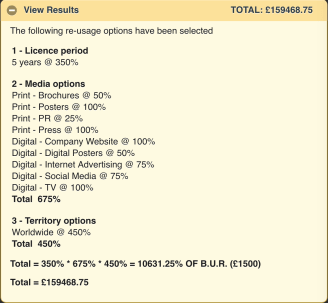
However, this doesn’t include any costs for models that may be required, renting studio space, permits for working in public areas i.e. having to temporarily close roads for work.
Examples of commissioned work:


(POTE)


(MOORE)
Ultimately, the goal for most fine art photographers is to have their work shown in galleries or museums by either being offered to exhibit their work or applying to exhibit their work. On getting started with exhibiting your work, Shoot Factory (CAPPER, 2018, www) suggest beginning by having a good online presence i.e. posting regularly on Instagram, Facebook, or and other kinds of social media where you can post your work as well as interacting with your followers. Not only will you reach a wide variety of types of people and organisations you may not have access to normally, you can also use online resources to network with models, MUAs, photographers, and any other kinds of creatives working in industry. By gaining a following online and paying attention to the demographics who are interested in your work it will give you a better idea of what the turnout to any future exhibitions may be, as well as increasing your chances of a good turnout by marketing your exhibition online.
Once you have completed a piece or series of work that you are ready to exhibit, you have to consider the costing of putting on an exhibition. Some exhibitions you pay up front for the wall space with 0% commission on each piece you sell going to the gallery like in London’s Brick Lane Gallery (THE BRICK LANE GALLERY, 2018, www). You can choose from a space of 3 meters (for beginners) for £660, 6 meters (for established artists) at £1320, or 9 meters for £1980. By paying up front for the space, The Brick Lane Gallery offer you 100% of the sales you make on each piece.
Other galleries may take a commission from each sale of your work to cover the cost of their marketing, promotion, and housing of the exhibition. On Artquest’s website (COHAN-PETROLINO, 2011, www), they state that galleries add anywhere between 33% and 100% on top of your selling price as their commission for putting on your exhibition. They also add that when selling in more specialist or boutique shops commission can reach as high as 250%! Therefore, if selling one piece normally at £1000, you would have to put your price up to £3500 to make the original £1000 asking price after you have paid out your commission. Artquest also write that the commission paid to whomever puts on your exhibition should be negotiated beforehand and part of your contract with the venue. This also doesn’t include any considerations on VAT! Artweeks’ (ART WEEKS, 2015, www) provides a handy breakdown of adding commission and VAT to your selling price:
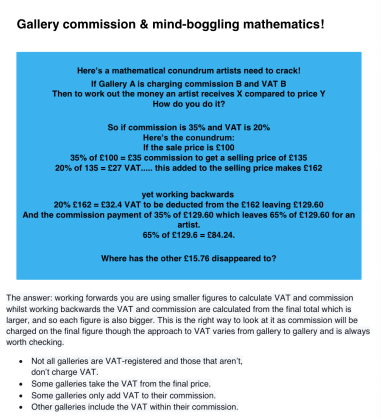
Artweeks highlights that some galleries aren’t VAT-registered and so do not charge VAT, and that galleries that do charge VAT charge it in different ways from including it in the price of commission, adding it to the commission, and deducting it from the final price. However, at this point you still need to consider the cost of printing, mounting, or framing your work, the cost of which is covered by you (the artist)!
From Loxley’s website (LOXLEY COLOUR, 2018, www), they offer a variety of different sizes including square sizes, panoramic, “standard” sizes, and “A” sizes. Focusing only on A sizing; if you were to order A0 and A1 sizes you would pay £47.07 per A0 print for between 1 and 9 prints, £40.01 per print for orders of 10-49, and £35.30 per print for 50+. For A1 sizes it would be £21.71 for 1-9, £18.45 for 10-49, and £16.28 for 50+. This costing is for the prints only in either gloss of lustre finish. Mounting options are available however, this also doesn’t include any kind of frames. According to Cameron Knight at Tuts+ (KNIGHTS, 2010, www), “framing can easily be the most expensive part of your show”. You can opt to purchase cheaper frames however, not only will their look reflect their cost, but they also won’t be as good quality. Overall presentation of your exhibition is what will help encourage sales and so success is in the details. Welsh artist and gallery owner, Alison Bradley (BRADLEY, 2004-18, www), offers a variety of price ranges in their framing services and offer a guide to framing quotes on their website: unmounted printed, A1: £180-£2300 (common £300), mounted print, A1: £120-£1600 (common £190). So, if you were to put on an exhibition with 10 A1 prints with mid-range priced framing at £1060 (2300-180/2) per print you would be looking at a total of £10,060 for framing with a cost of £400.10 for prints, totalling £10,460.10. Of course, when putting on an exhibition you are more likely to have a variety of sized prints depending on your chosen crop, the camera you used (large format, full frame, cropped frame), and the overall statement of the image. You may have some images that are square in shape, some panoramic, and a mix of landscape and portrait images and so this costing total is intended as a general example.
Overall, putting on exhibitions can be expensive regardless of whether you pay for the space and all marketing with no commission on your work, or the gallery provides the space and all marketing but adds commission and possibly VAT as well. You are still required to front the cost of the printing and mounting or framing. However, if you are well known and likely to sell a lot of your work then the payback can be worth it! According to fstoppers (YORK, 2018, www), fine art photographer Jason Matias made $60,000 (£46,140) selling fine art prints in 2017 alone, and American photographer Cindy Sherman charges upwards of $40,000 (£30,768) for one piece of work (BORDELON, 2010, www). Unfortunately, I struggled to find an example of a UK based fine art photographer cost per print however, on WORLDPHOTO (PANOMIS, 2016, www), it states that 44% of art buyers spend £10,000 on art online, and 22% of the aforementioned buyers spent over £50,000 on online art. From the British Art Market Federation (ARTS ECONOMICS, 2017, www), we know that in 2016 alone the Art Trade contributed £1,462.2 million to the UK economy, 45% of which is from sales of “Post-War and Contemporary” works which are defined as art that is created by individuals born after 1910.
Other ways for fine art photographers to create passive income from their work is to sell books; Australian photographer Peter Lik offers a variety of books which display his images priced between $95 and $2950 (£73.05-£2268.36). If he sold 10 copies of his more expensive priced books per year, and 50 of his cheapest priced he would make a total of £26,3361.1 from book sales alone. Roger Lane, a Dorset based photographer, sells his latest book “Thruxton Revisited – A 50th Celebration” for £29.19 per each softcover, and £34.19 per each hardcover. Lane has authored several books, and if he were to price all of them the same (hypothetically) then by selling 500 books per year at £29.19 each and 300 books per year at £34.19 he would gain a passive income of £24,852 per year from book sales alone.
In conclusion, fine art photographers come from a variety of educational and employment backgrounds, but all must share a good sense of business and marketing skills, as well as knowing how to reach a range of audiences and vary their selling potential by gaining work from commissions, selling prints online, selling books, and exhibiting and then selling works in galleries. It is not an easy profession to be successful in however, with hard work, dedication, and business savvy it is manageable, and for some (like Peter Lik) can be most profitable.
Bibliography
Online Sources
- GRANDE, C. 2014. HIGHLIGHTED CASES: GRAYSON PERRY, ARTIST. [online]. The Creative Industries. Available from: http://www.thecreativeindustries.co.uk/uk-creative-overview/highlighted-cases/cross-industry-collaboration-award/grayson-perry [Accessed 16th October 2018]
- ROYAL ACADEMY, 2018. GRAYSON PERRY RA. [online]. Royal Academy. Available from: https://www.royalacademy.org.uk/art-artists/name/grayson-perry-ra [Accessed 16th October 2018]
- PYCROFT, 2016. DCMS Sectors Economic Estimates 2016: Trade. [online]. Department for Digital, Culture, Media, & Sport. Available from: https://assets.publishing.service.gov.uk/government/uploads/system/uploads/attachment_data/file/731948/DCMS_Sectors_Economic_Estimates_2016_Trade_final.pdf [Accessed 16th October 2018]
- GRANDE, C. 2014. NEWS AND VIEWS: CREATIVE SERVICES EXPORTS REACH £27B. [online]. The Creative Industries. Available from: http://www.thecreativeindustries.co.uk/uk-creative-overview/news-and-views/news-creative-services-exports-grow-to-%C2%A327bn [Accessed 16th October 2018]
- PATEL, L. 2017. Creative Industries contribute £92bn to UK economy. [online]. Asians In Tech. Available from: https://asiansintech.com/creative-industries-contribute-92bn-uk-economy/ [Accessed 16th October 2018]
- VISUAL ARTS CORK, 2015. Fine Art Photography History of Photographic Art, Most Expensive Photos. [online]. Visual Arts Cork. Available from: http://www.visual-arts-cork.com/fine-art-photography.htm [Accessed 19th October 2018]
- UNCHAPHER, B. 2017. What is Fine Art Photography? [online]. Photography Life. Available from: https://photographylife.com/what-is-fine-art-photography [Accessed 19th October 2018]
- BORDELON, G. 2010. How Much Money Do Fine Art Photographers Make? [online]. Chron. Available from: https://work.chron.com/much-money-fine-arts-photographers-make-18046.html [Accessed 19th October 2018]
- LAGERSTEDT, M. [online]. Available from: https://www.mikkolagerstedt.com/alone [Accessed 23rd October 2018]
- LAGERSTEDT, M. [online]. Available from: https://www.mikkolagerstedt.com/about/ [Accessed 23rd October 2018]
- TURNOVSKY, H. Contact & Bio. [online]. Available from: http://turnovsky.com/contact_and_bio.html [Accessed 23rd October 2018]
- TURNOVSKY, H. 2014. Portable Places. [online]. Available from: http://turnovsky.com/photography/portable%20places.html [Accessed 23rd October 2018]
- COOPER, J. About GSA. [online]. Available from: http://www.gsa.ac.uk/about-gsa/our-people/our-staff/c/cooper-thomas-joshua/ [Accessed 23rd October 2018]
- STEWART, J. 2017. How to Use Crowdfunding to Launch the Creative Project of Your Dreams. [online]. My Modern Met. Available from: https://mymodernmet.com/crowdfunding-for-creatives/ [Accessed 27th October 2018]
- https://www.patreon.com/about [Accessed 27th October 2018]
- FISHER, S. 2018. VEAL CALVES. [online]. Available from: https://www.sammanthafisher.com/vealcalves [Accessed 27th October 2018]
- FISHER, S. 2018. [online]. Available from: https://www.patreon.com/sfisherx/overview [Accessed 27th October 2018]
- CREATIVE SCOTLAND. Funding. [online]. Available from: https://www.creativescotland.com/funding [Accessed 29th October 2018]
- ROYAL SCOTTISH ACADEMY. 2018. RSA RESIDENCIES FOR SCOTLAND. [online]. Available from: https://www.royalscottishacademy.org/artist/rsa-residencies-for-scotland/ [Accessed 29th October 2018]
- ROYAL SCOTTISH ACADEMY. 2018. THE RSA MORTON AWARD. [online]. Available from: https://www.royalscottishacademy.org/artist/the-morton-award/ [Accessed 29th October 2018]
- CURRENCY CONVERTER. 2018. [online]. Available from: https://www.currencyconverterrate.com/usd/300-usd-to-gbp.html [Accessed 29th October 2018]
- SILLARS, R. 2018. HOW MUCH SHOULD PHOTOGRAPHERS CHARGE IN 2018. [online]. DIYPhotography. Available from: https://www.diyphotography.net/much-photographers-charge-2018/ [Accessed 29th October 2018]
- LONDON FREELANCE. 2018. Freelance Fees Guide: Advice – Photography / Day/base rates. [online]. London: London Freelance Available from: http://www.londonfreelance.org/feesguide/index.php?language=en&country=UK§ion=Photography&subsect=Day/base+rates&page=Advice [Accessed 29th October 2018]
- 2018. Usage Calculator. [online]. The AOP. Available from: https://www.the-aop.org/information/usage-calculator [Accessed 29th October 2018]
- POTE, D. Scarborough Hospital AE. [online]. Available from: http://www.dominicpote.co.uk/scarborough-hospital-ae [Accessed 29th October 2018]
- MOORE, T. VARIOUS (unknown). Architectural Commercial Photography. [online]. Available from: http://tonymoorephotography.com/architectural-commercial-photography/ [Accessed 30th October 2018]
- CAPPER, T. 2018. EXHIBITING YOUR PHOTOGRAPHY WORK. [online]. SHOOT FACTORY. Available from: https://www.shootfactory.co.uk/exhibiting-photography-work/ [Accessed 30th October 2018]
- THE BRICK LANE GALLERY. 2018. EXHIBIT WITH US. [online]. Available from: https://thebricklanegallery.com/call-for-artists-exhibit-with-us [Accessed 30th October 2018]
- LOXLEY COLOUR. 2018. Photographic Prints. [online]. Available from: https://www.loxleycolour.com/prints/prints-mounting/photoprints#sizes [Accessed 30th October 2018]
- KNIGHT, C. 2010. A Guide to Preparing Your First Gallery Exhibition. [online]. Tuts+. Available from: https://photography.tutsplus.com/articles/a-guide-to-preparing-your-first-gallery-exhibition–photo-4036 [Accessed 30th October 2018]
- BRADELY, A. 2018. Framing Guide Prices. [online]. Available from: https://www.alisonbradley.gallery/framing-guide-prices/ [Accessed 30th October 2018]
- COHAN-PETROLINO, M. 2011. Gallery commission. [online]. Artquest. Available from: https://www.artquest.org.uk/how-to-articles/gallery-commission/ [Accessed 30th October 2018]
- 2015. Gallery commission & mind-boggling mathematics. [online]. Artweeks. Available from: https://www.artweeks.org/sites/default/files/manual/Gallery%20commissions.pdf [Accessed 30th October 2018]
- YORK, N. 2018. How to Make $60,000 in One Year Selling Fine Art Photographs. [online]. fstoppers. Available from: https://fstoppers.com/business/how-make-60000-one-year-selling-fine-art-photographs-213373 [Accessed 31st October 2018]
- ARTS ECONOMICS. 2017. The British Art Market. [online]. British Art Market Federation. Available from: http://tbamf.org.uk/wp-content/uploads/2014/08/The-British-Art-Market-2017.pdf [Accessed 31st October 2018]
- LIK, M. 2018. [online]. Available from: https://lik.com/collections/all/product_book [Accessed 31st October 2018]
- LANE, R. 2018. ROGER LANE LANDSCAPE AND FINE ART PHOTOGRAPHY. [online]. Available from: http://www.rogerlanephotography.com/ [Accessed 31st October 2018]
- LANE, R. 2018. Thruxton Revisited – A 50th [online]. blurb. Available from: http://www.blurb.co.uk/b/8605537-thruxton-revisited-a-50th-celebration [Accessed 31st October 2018]
- CAMPAIGN LIVE. 2018. O2 “Breathe it all in” by VCCP. [online]. Available from: https://www.campaignlive.co.uk/article/o2-breathe-in-vccp/1491667 [Accessed 11th November 2018]
 Jade Taylor Photography